to be or not to be – czasownik to be – być
Kiedy używamy to be?
Niezwykle ważny w języku angielskim, jeden z podstawowych czasowników podobnie jak “to have” oraz “to do”. Jeśli go opanujesz, to łatwiej zrozumiesz kolejne czasy i konstrukcje w angielskim. Przyjmuje różne formy np: am , are, is, was , were, been , be itp.
Opisywanie stanu, cech, emocji
I am tired.
Jestem zmęczony. / Jestem zmęczona.
She is happy.
Ona jest szczęśliwa.
I was tired yesterday.
Wczoraj byłem zmęczony. / Wczoraj byłam zmęczona.
Informacje o wieku, zawodzie, narodowości
He is 20 years old.
On ma 20 lat.
They are Polish.
Oni są Polakami. / One są Polkami.
He was 20 years old when he started college.
On miał 20 lat, kiedy zaczął studia.
They were engineers before the company closed.
Oni byli inżynierami, zanim firma została zamknięta./ One były inżynierami…
They have been doctors since 2020.
Oni są lekarzami od 2020 roku. / One są lekarkami…
Lokalizacja
The keys are on the table.
Klucze są na stole.
The bags were in the car an hour ago.
Torby były w samochodzie godzinę temu.
The keys will be on the table later.
Klucze będą na stole później.
Budowanie strony biernej
The car was repaired yesterday.
Samochód został naprawiony wczoraj.
The car is being repaired.
Samochód jest naprawiany.(właśnie)
The car will be repaired tomorrow.
Samochód zostanie naprawiony jutro.
Budowanie czasów ciągłych (Continuous)
I am working.
Pracuję. / Ja pracuję.
They were sleeping.
Oni spali. / One spały.
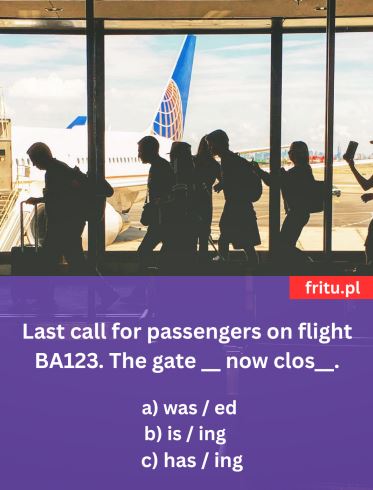
Last call for passengers on flight BA123. The gate is now closing.
Ostatnie wezwanie dla pasażerów lotu BA123. Bramka właśnie się zamyka.
the gate to rzecz = “it”, dla it używamy “to be” jako “is”.
Bramka zamyka się “now” teraz, więc czas teraźniejszy ciągły – Present Continuous, więc czasownik “close” z końcówką +ing.
The gate is now closing.
Czasownik “to be” w czasie Present Simple – teraźniejszość
| Osoba | Twierdzenie | Przeczenie | Pytanie | Przykład |
|---|---|---|---|---|
| I | am | am not | Am I…? | I am happy. |
| you | are | are not / aren’t | Are you…? | You are ready. |
| he | is | is not / isn’t | Is he…? | He is tall. |
| she | is | is not / isn’t | Is she…? | She is a doctor. |
| it | is | is not / isn’t | Is it…? | It is cold. |
| we | are | are not / aren’t | Are we…? | We are at home. |
| you | are | are not / aren’t | Are you…? | You are students. |
| they | are | are not / aren’t | Are they…? | They are Polish. |
Czasownik “to be” w czasie Past Simple – przeszłość
| Osoba | Twierdzenie | Przeczenie | Pytanie | Przykład |
|---|---|---|---|---|
| I | was | was not / wasn’t | Was I…? | I was tired yesterday. |
| you | were | were not / weren’t | Were you…? | You were at school. |
| he | was | was not / wasn’t | Was he…? | He was happy. |
| she | was | was not / wasn’t | Was she…? | She was a student. |
| it | was | was not / wasn’t | Was it…? | It was cold. |
| we | were | were not / weren’t | Were we…? | We were in the park. |
| you | were | were not / weren’t | Were you…? | You were ready. |
| they | were | were not / weren’t | Were they…? | They were Polish. |
Let’s speak English.
Małe grupy.
DUUUŻA
SWOBODA
MÓWIENIA.
Czas się przełamać!



czasownik “to be” w czasie Future Simple – przyszłość
| Osoba | Twierdzenie | Przeczenie | Pytanie | Przykład |
|---|---|---|---|---|
| I | will be | will not / won’t be | Will I…? | I will be ready soon. |
| you | will be | will not / won’t be | Will you…? | You will be happy. |
| he | will be | will not / won’t be | Will he…? | He will be a doctor. |
| she | will be | will not / won’t be | Will she…? | She will be late. |
| it | will be | will not / won’t be | Will it…? | It will be sunny tomorrow. |
| we | will be | will not / won’t be | Will we…? | We will be at home. |
| you | will be | will not / won’t be | Will you…? | You will be surprised. |
| they | will be | will not / won’t be | Will they…? | They will be here soon. |
Czasownik “to be” w czasach continuous i perfect.
W czasach continuous (w stronie biernej) np Present Continuous, Past Continuous zmienia się z “to be” na “being”.
W czasie Future Continuous będzie tylko “be” – (występuje po “will” czasownik modalny)
We are being served.
Jesteśmy obsługiwani.(właśnie teraz) / Jesteśmy obsługiwane. (właśnie teraz)
She was being treated well.
Była dobrze traktowana.
At this time tomorrow, she will be playing video games again.
Jutro o tej porze ona znowu będzie grała w gry wideo.
W czasach Perfect zamieniasz “to be” na “been”
You have been helpful.
Byłeś pomocny. / Byłaś pomocna / Byliście pomocni / Byłyście pomocne.
She has been tired.
Ona była zmęczona.
They had been tired before the break.
Byli zmęczeni przed przerwą.
Next year they will have been married for 5 years.
W przyszłym roku minie 5 lat, odkąd są małżeństwem.
Jeszcze jest tyle do odkrycia….
-
Mała różnica, spore nieporozumienie! Jak używać Much, Many, A Few i A Little, Few, Little, żeby brzmieć poprawnie?
Ile masz dzisiaj zadań do zrobienia? Ile masz pieniędzy? much…
-
Wiele osób robi ten błąd! Sprawdź, czy poprawnie używasz there is oraz there are — dużo przykładów, jasno wytłumaczone.
Często zdarza się, że chcemy powiedzieć o istnieniu czegoś ,…
-
At, on, in, obok, naprzeciwko, pomiędzy… Jak opisywać przestrzeń po angielsku i odnaleźć się za granicą? Prepositions of Place and Movement w praktyce — z wieloma przykładami
chcesz zapytać, gdzie można kupić bilety na dworcu. Trzeba zapytać…
-
Trochę, kilka, żadne, jakiekolwiek… Jak to powiedzieć po angielsku i kiedy tego używać?
Wiele osób myli lub niepoprawnie używa some i any, zarówno…
-
Ten, tamten, ci, te – kiedy i jak używać w języku angielskim? Zaimki wskazujące prosto wyjaśnione, dużo przykładów.
This is exactly what I needed. I love this color. To…
-
Wielu popełnia ten błąd. Sprawdź, czy poprawnie używasz Possessive Adjectives i Pronouns.
Jeśli chcesz powiedzieć w języku angielskim, że coś należy do…
-
Zero Article w angielskim: zasada, którą native speakerzy znają od dziecka… a Ty wciąż ją łamiesz. Przykłady.
NO ARTICLE – kiedy nie stawiamy w języku angielskim “the”,…
-
Dlaczego Anglicy mówią ‘the bank’, ‘the doctor’, ‘the cinema’? Odpowiedź Cię zaskoczy. Kiedy używać ‘the’ w języku angielskim?
Gdzie wstawić “the”? „The” używamy przed rzeczownikami (osoba, rzecz itp.)…
-
„A” czy „An”? Wybór, który może zdradzić Twój poziom angielskiego. Przedimek, dużo przykładów.
Dlaczego mówimy „a cat”, ale „an apple”? W języku angielskim…
-
Rzeczowniki w języku angielskim (NOUNS) i na jakie pytania odpowiadają? Przykłady, liczba mnoga, użycie.
Co to jest rzeczownik(noun) w języku angielskim? Na jakie pytania…